
No Agreed Text, No Decision on the Merits?
EPO
Rui Wang
6/18/20263 min read
1. Introduction
A recent Board of Appeal decision (T 0742/24) addressed a purely procedural question: what happens when a patent proprietor withdraws its approval of the text of the patent and of all pending auxiliary requests during appeal proceedings?
The decision did not concern novelty, inventive step or any other substantive ground of opposition. Instead, it focused on the application of Article 113(2) EPC. Although the underlying principle has been established in EPO practice since T 73/84, the Board provided a detailed analysis of the rationale behind that approach.
2. Can the Board Still Decide on the Substance?
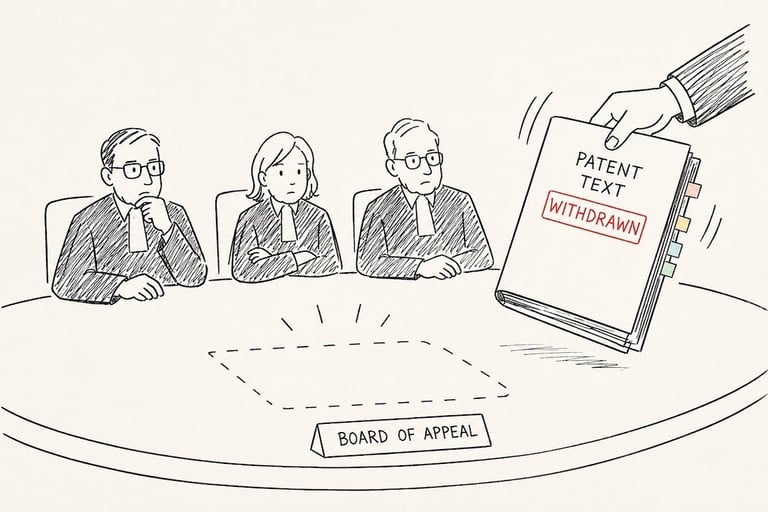
The opposition division had rejected the opposition and the opponent appealed. During the appeal proceedings, the Board issued a preliminary opinion indicating that none of the proprietor’s requests appeared allowable and that the patent was likely to be revoked. The proprietor subsequently withdrew its approval of the text of the patent and later confirmed that the withdrawal extended to all auxiliary requests. As a result, no claim request approved by the proprietor remained on file.
The opponent nevertheless requested that the Board decide on the substantive grounds of opposition and issue a decision containing substantive reasoning. Its principal argument was based on the wording of Article 113(2) EPC, according to which the EPO shall examine and decide upon the patent only in the text “submitted to it, or agreed, by the proprietor”. Since the provision uses the word “or”, the opponent argued that these were two independent conditions. Accordingly, a text previously submitted by the proprietor should remain available as a basis for decision even after approval of that text had been withdrawn.
The Board did not accept that interpretation. In its view, Article 113(2) EPC governs the conditions under which the EPO may examine and decide and therefore refers to the legal situation existing at the time the decision is taken. More fundamentally, the purpose of the provision is to ensure that the applicant or proprietor retains control over the text on which the EPO decides. That purpose would be undermined if the EPO could continue to decide on a text which the proprietor had expressly stated it no longer approved.
The Board therefore concluded that the term “submitted” does not merely refer to a historical act of filing. Rather, both “submitted” and “agreed” reflect the same underlying requirement: at the time the decision is taken, there must be a text which the proprietor currently approves. Since no such text existed in the present case, substantive examination was no longer possible.
3. Obiter Dicta and the Request for Referral
The opponent further argued that, even if the Board could no longer issue a substantive decision, it could still include comments on patentability in the form of obiter dicta. The Board disagreed. It observed that obiter dicta do not form part of the legally operative reasoning of a decision and are included only in exceptional circumstances. Their purpose is not to substitute for a substantive assessment where the procedural conditions for such an assessment are absent. The Board therefore saw no reason to comment on the allowability of requests that had been withdrawn.
The opponent also requested a referral to the Enlarged Board of Appeal. The Board noted that, under Article 112(1)(a) EPC, a referral is only justified where an answer from the Enlarged Board is required for deciding the case. In the present proceedings, however, the outcome would be the same regardless of how the proposed questions were answered. Since no approved text remained on file, the patent would be revoked in any event. The proposed questions could affect the reasoning but not the outcome. The request for referral was therefore rejected.
4. Concluding Remarks
The decision highlights an important feature of EPO proceedings: procedural issues can sometimes determine the outcome of a case without any need to address the substantive grounds of opposition.
For proprietors, this may raise a strategic consideration when a patent appears unlikely to survive. The question is not always limited to whether the patent will ultimately be revoked, but also whether there is any benefit in obtaining a substantive decision on issues such as inventive step, technical effect or claim amendments. While such a decision may provide useful guidance for related proceedings, it may also create a detailed record of adverse findings that could later be cited in parallel cases, divisional applications or patent litigation.
T 0742/24 therefore serves as a reminder that, in EPO practice, the absence of an approved text is not merely a procedural formality. It may determine whether the Board addresses substantive patentability issues at all.
DISCLAIMER: The content of this website is provided for general informational purposes only and reflects the author's understanding of the law as of the date of publication. It does not constitute legal advice and should not be relied upon as a substitute for legal advice in any specific matter.
Subsequent developments in legislation, case law, administrative practice or official guidance may affect the accuracy or continued relevance of the content.