


Essentiality Is Not the Question — Reading T 0417/25
EPO
Rui Wang
7/23/2026
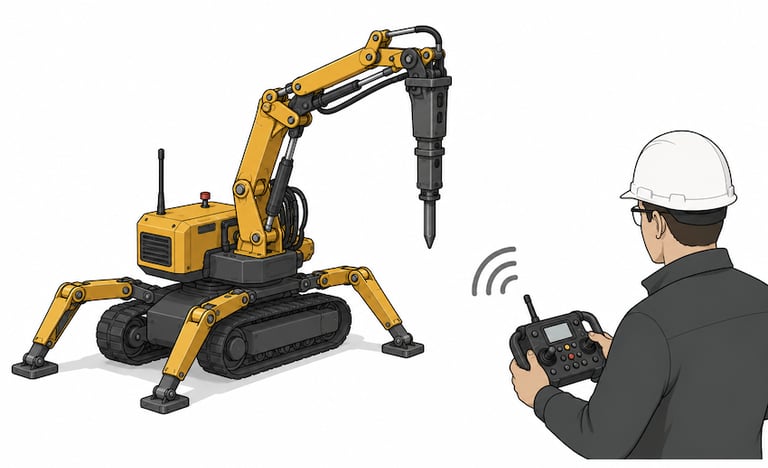
Demolition robots are typically operated remotely. Rather than standing next to the machine, the operator controls the robot from a safe distance using a handheld remote control. Such robots are commonly equipped with a boom, a hydraulic breaker and outriggers, with the various functions assigned to joysticks and buttons on the controller.
A recent decision of the EPO Boards of Appeal, T 0417/25, concerns this type of remotely controlled demolition robot. What makes the decision particularly interesting, however, is not the control arrangement itself, but a drafting issue that occasionally arises in practice.
1. Can an ambiguity in an original claim show that a feature was originally optional?
Original claim 1 ended with the following limitation:
”…wherein at least one joystick (24) is provided with at least one top control switch (25), and wherein the outriggers (15) are associated with the top control switch (25) of the first joystick (24a).”
The difficulty was that, before this limitation, the claim had not introduced “the outriggers” as part of the demolition robot. During examination, the applicant deleted the limitation relating to the outriggers. In the subsequent opposition and appeal proceedings, the proprietor argued that the amendment did not add subject-matter. Since the claim merely referred to “the outriggers” without any antecedent basis, this was an indication that the "outriggers" were not necessarily part of the "demolition robot". In addition, the description disclosed the top control switch and certain outrigger commands as optional.
The Board was not persuaded.
It first acknowledged that the original claim was indeed ambiguous:
“The lack of antecedent for ‘the outriggers’ introduces ambiguity in original claim 1.”
However, it immediately added:
“But such ambiguity cannot be used to prove that the ‘outriggers’ and their control need not be part of the ‘remote-controlled demolition robot’. Rather, original claim 1 further stresses that the ‘outriggers’ indeed form part of the claimed subject-matter and nothing in the description as originally filed indicates that they were merely optional.”
In other words, a drafting ambiguity cannot be relied upon to show that a feature was originally disclosed as optional.
The Board also rejected the proprietor’s reliance on the description. The cited passages "merely relates to the optional provision of 'outrigger commands' ... but not to the very presence of the 'outriggers' and their control in the claimed 'demolition robot'" . An optional control function is therefore not the same as an optional structural feature.
2. The Essentiality Test and the Gold Standard
The Board’s final observation also illustrates why the essentiality test could not determine the outcome:
“It might well be that, confronted with the appropriate task, the skilled person would modify the original ‘demolition robot’ and omit the ‘outriggers’, using their common general knowledge, without the involvement of an inventive step. But this is not the same as being ‘directly and unambiguously derivable’ from the application as filed.”
Since G 2/10, the Gold Standard has been the governing test under Article 123(2) EPC. The EPO Guidelines likewise explain that, although the three-point (essentiality) test is often applied when assessing the deletion of a feature, compliance with that test is not decisive. The amendment must ultimately satisfy the Gold Standard.
T 0417/25 provides a good example of that distinction.
Even if the skilled person could readily design a demolition robot without outriggers, that does not mean that such a robot was directly and unambiguously derivable from the application as filed. Under Article 123(2) EPC, the question is not what the skilled person could have done, but what the application actually disclosed.
3. Concluding Remarks
T 0417/25 does not establish a new principle under Article 123(2) EPC. It does, however, offer a practical reminder: a drafting ambiguity may create uncertainty, but it cannot turn a technical feature into an optional one.
The decision also illustrates that, even where the essentiality test is considered, the assessment under Article 123(2) EPC must ultimately return to the Gold Standard.
DISCLAIMER: The content of this website is provided for general informational purposes only and reflects the author's understanding of the law as of the date of publication. It does not constitute legal advice and should not be relied upon as a substitute for legal advice in any specific matter.
Subsequent developments in legislation, case law, administrative practice or official guidance may affect the accuracy or continued relevance of the content.