


Can Simultaneous Display Support Inventive Step? — T 1438/24
EPO
Rui Wang
6/26/2026
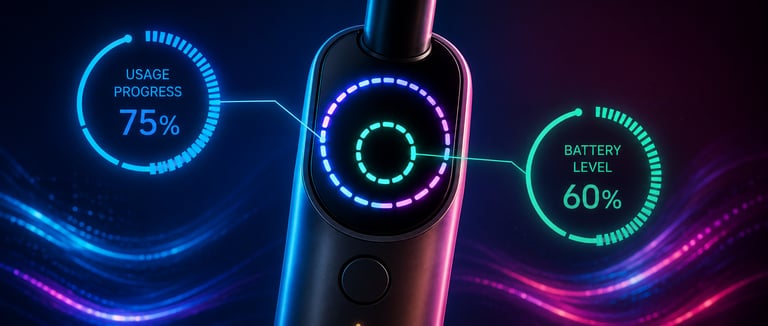
The EPO Board of Appeal’s recent decision T 1438/24 (Two-array LED display / Philip Morris) addresses an interesting question in the assessment of GUI-related inventions.
If an interface presents information that was previously displayed separately simultaneously, can that distinction support inventive step?
According to the Board, the answer is no.
1. The distinguishing feature was merely the simultaneous presentation of information
The patent application concerned an aerosol-generating device comprising two LED display areas.
An outer lighting array indicated the progress of a usage session, while an inner lighting array displayed another technical condition of the device, such as battery status or an operating mode.
The applicant argued that displaying two technical conditions simultaneously enabled users to better understand the current state of the device and therefore involved an inventive step.
The Board disagreed.
In its view,
“The actual difference between claim 1 and D1 resides solely in the decision to present different technical conditions simultaneously.”
In other words, D1 already disclosed the display of the same technical conditions. The only difference was that they were presented one at a time, whereas the claimed invention displayed them simultaneously.
2. G1/24 does not permit limitations from the description to be read into the claims
The decision is also noteworthy because it is among the first to discuss the Enlarged Board’s recent decision G 1/24.
The applicant argued that, since G 1/24 requires the description and drawings to be consulted when interpreting the claims for assessing patentability, the claimed inner and outer lighting arrays should be interpreted in light of the embodiment as corresponding to two separate display windows.
If accepted, this interpretation would establish not only a difference in software control but also a structural distinction over D1.
The Board rejected that argument.
According to the Board, although G 1/24 requires the description and drawings to be consulted, it does not justify reading limiting features from the embodiments into the claims. Since claim 1 neither expressly nor implicitly required two separate display windows, such a limitation could not be imported merely from the description.
Consequently, the Board maintained that there was no structural difference over D1. The distinguishing features lay solely in the way the LEDs were controlled.
3. The decisive question is whether the distinguishing features produce a technical effect
The applicant further argued that simultaneously displaying two technical conditions improved user interaction with the device and therefore produced a technical effect.
The Board accepted the general proposition that the automatic presentation of technical conditions of a technical apparatus may, in principle, produce a technical effect, particularly where the displayed information assists the user in interacting with the apparatus.
However, it found that no such effect was achieved in the present case.
Displaying two technical conditions simultaneously did not provide the user with any additional insight into the internal operation of the device, nor did it improve the technical functioning of the device itself.
As the Board explained,
“This does not provide the user with any additional insight into the internal operation of the device beyond what is already disclosed in D1.”
The difference therefore concerned only how existing information was presented, rather than any technical improvement.
4. Improved Clarity or convenience may merely reflect user preference
The applicant also argued that simultaneous presentation made the interface clearer and more convenient by reducing the need to switch between different displays.
The Board was not persuaded.
It observed that user preferences inevitably differ. While some users may consider simultaneous presentation clearer, others may regard it as cluttered or less legible.
Accordingly, effects such as improved clarity or reduced cognitive burden merely reflect subjective user preferences and do not constitute technical effects capable of supporting inventive step.
5. Takeaway
The decision does not introduce a new principle under the COMVIK approach.
It does, however, reinforce an important point in GUI case law.
The assessment of inventive step does not depend on how much information is displayed, but on whether the distinguishing features contribute to a technical effect.
Where the only distinction lies in presenting existing information simultaneously, without changing the technical operation of the device or assisting the user in performing a technical task, that distinction will generally remain presentation of information as such and will not support inventive step.
DISCLAIMER: The content of this website is provided for general informational purposes only and reflects the author's understanding of the law as of the date of publication. It does not constitute legal advice and should not be relied upon as a substitute for legal advice in any specific matter.
Subsequent developments in legislation, case law, administrative practice or official guidance may affect the accuracy or continued relevance of the content.